|
|
|
|
History
|
The first inhabitants were the Arawak Indians, which lived in The Islands Of The
Bahamas as early as 300 to 400 AD. They were later followed by Lucayan Indians.
Neither group of people left a written history, but what they did leave --
drawings, pottery, tools and bones -- gives insight into their daily lives. There
were 40,000 Lucayans when Columbus arrived in 1492, but this population soon
dwindled to nothing after being enslaved.
It was not until the mid 1600's that New Providence (known today as Paradise
Island) was first inhabited by Bermudians, who were originally English pioneers.
The settlers immediately recognized that Paradise Island would be an ideal
shipping harbor. From then on, Paradise Island would see many different
government rules and land owners, but would remain primarily a dockyard and
shipyard, as well as a coaling station during the Civil War. It was not until
the 1890's that pleasure seekers discovered the beautiful beaches of Paradise
Island, and several private estate owners realized the financial opportunities
available to them. The proprietors found it to be a good idea to convert their
summer homes into bathhouses during the winter months. As interest in the island
grew, several businessmen independently recognized the golden opportunity of
developing Paradise Island into a tourist destination. By the year 1901, three
"pleasure resorts" had successfully opened on Paradise Island, marking the
beginning of an era that continues today. The Islands Of The Bahamas attained
independence in 1973, but retains a symbolic link with Great Britain and remains
part of the British Commonwealth.
|
|
[ top ]
|
|
Culture
|
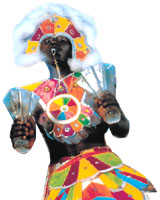
Bahamians are dynamic, independent and friendly people who love music. The
Bahamas is known for its Goombay melody. The centerpiece of Bahamian culture is
the annual Junkanoo festival, which attracts many avid fans from all over the
world with its energetic, colorful parade of brightly costumed people and
exciting musical instruments. Some artists -- like Amos Ferguson, Maxwell Taylor
and Stan Burnside -- have attained international acclaim. Ferguson's works are on
permanent display at the Pompey Museum in Nassau.
|
|
[ top ]
|
|
Currency
|
The Bahamian dollar is on par with the US dollar; however, one can expect to pay
a small commission when exchanging traveller's cheques for local currency and
when converting local currency into US dollars. Across the island you'll find
that US currency is widely accepted.
|
|
[ top ]
|
|
Temperatures
|
Paradise Island has ideal, tropical weather year-round. The most
refreshing time is from September through May when the temperature averages 70-75
degrees Fahrenheit. The rest of the year is a bit warmer with temperatures
between 80-85 degrees. Rainfall is scarce from November through April each year.
|
|
[ top ]
|
|
General Information
|
The Bahamas is on Eastern Standard Time and follows U.S. daylight savings times from April to October.
Electricity:
You won't need any special power or voltage adaptors for your hairdryer or other
small 110V appliances. (An adapter is required for 220 V appliances.) Power outages
happen occassionally and repairs are prompt, with power being quickly restored if
it does go out.
Immigration:
When you travel to The Bahamas you are given an immigration card to fill in. The Immigration officer at the point of entry pulls the card and leaves you with the stub. Be sure to return this portion to the ticket agent upon departure.
You must provide proof of U.S. citizenship or residency and a driver's license or other photo id. Valid documents include:
• Birth certificate or certified copy with photo id.
• Passport (Valid or recently expired so the photo resembles the bearer.)
• US naturalization card with two picture ids.
• US alien registration card with two picture ids.
Each person, except children 6 and under, must pay a departure tax of $18 at the airport upon leaving the island.*
|
| *Tax subject to change, please call for information.
|
|
[ top ]
|
|










 Paradise Island, appropriately named for its pristine beauty, is surrounded by powder-soft, white sandy beaches and crystal clear waters. Paradise Island is about 160 air miles southeast of Miami, and is situated on 650-acres just across a bridged harbor from New Providence, Bahamas.